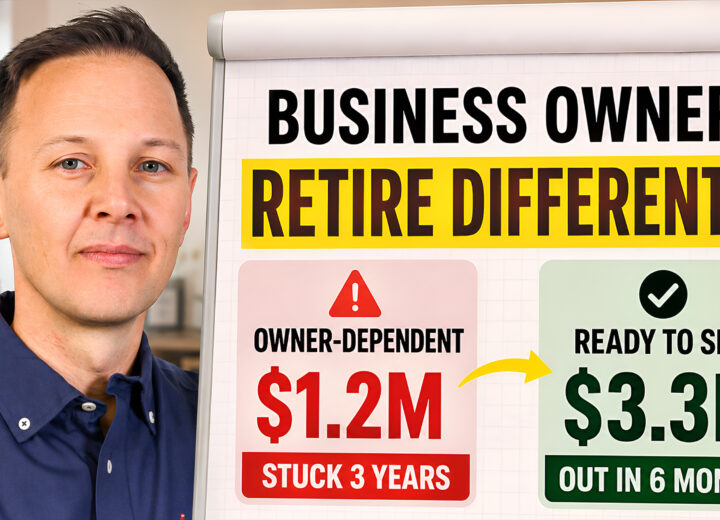
Founder Money Podcast — Episode 5 | By Curtis Hearn, CFP, CEPA, MBA
Watch/listen on your favorite platform: Spotify | Apple Podcasts | YouTube
It’s a little crazy when you say it out loud: most business owners cannot accurately answer the single most important financial question about the thing they have spent their life building.
What is it actually worth?
That is not a small gap. For most owners, 80% or more of their net worth is locked inside the business [1]. It is the asset that is supposed to fund the rest of their life.
And yet only about one in five businesses that go to market ever actually sell [2].
So this number is not academic. It is the difference between exiting on your terms and staying stuck.
Here is the problem with not knowing it. If you overestimate it, you build your entire financial future on a number that was never real, and then get blindsided when the offer comes in. If you underestimate it, you can sell yourself short and get taken advantage of later on. Either way, you are not doing your future financial self any favors.
But here is what matters even more: you never learn the key levers you can pull to increase your valuation over time. Instead, you find out the hard way, at the negotiating table, when it is far too late to change anything.
The good news is that your business valuation is not nearly as complicated as you might think. It comes down to a simple formula with two main variables: your profits and your multiple. Two levers you have far more control over than you have been led to believe.
In this episode I walk through how those variables are calculated, what moves your valuation up and down, the mistakes most owners make trying to game it, and what you can start doing today to put yourself in the strongest possible position when the time comes to sell.
Your Valuation Isn’t Fixed — It’s Built
Most owners I meet are convinced they already know what their business is worth. They have heard multiples thrown around. Maybe a competitor down the street sold a few years back. So they have a number in their head, and they are pretty comfortable with it.
The trouble is that the number is almost always a rough guess. And in my experience, it is almost always too optimistic.
When I suggest we actually dig in — pressure-test the real number, figure out what is driving it, and start moving it in the right direction — that is when I hear the line I hear over and over: “I’ll cross that bridge when I get to it.”
It is the same instinct we all have with a house. You do not think too hard about what it is worth until you are ready to move. You call a realtor, you let the market decide, you close. Maybe you even put a coat of paint over the scuff marks. And for real estate, that is fine. Your house’s value is not going to change dramatically in three years based on the decisions you make today.
Your business is a completely different animal.
Your valuation is not fixed, and it is not handed to you by the market the way a home appraisal is. It is built — or destroyed — by hundreds of decisions you make every single month. If you wait until you are ready to sell before you give it real thought, you have already missed the window to meaningfully change the number.
The owners who exit well, the ones who walk away on their own terms at a number they are proud of, are not the ones who got lucky. They are the ones who understood their value years before the sale and made deliberate adjustments along the way.
So what does “understanding your value” actually mean? It goes deeper than landing on a number, especially since the number in your head is probably too high. The real question is why. Why is it worth what it is worth? What is creating the value? What is dragging it down? What makes a buyer nervous, and what makes them confident? And most importantly: what can you actually change?
Once you understand the why, you stop pouring energy into things that feel productive but do not move the number, and you start focusing on the things that do.
This matters long before any exit, too. Understanding your valuation makes you a sharper operator today. It helps you secure better financing. It tells you where your business is vulnerable before a buyer finds it for you. And it gives you a clearer picture of your financial future instead of a hope.
The Formula: EBITDA × Your Multiple
Your valuation has two distinct components. Most owners only ever think about one of them, and that blind spot is exactly where money gets left on the table.
Component one: what the business earns
The first component comes straight from your financials, and it makes sense that this is where most of the attention goes, because it is the first thing a buyer wants to know: how much money does this business make?
The number they use to answer that is not your revenue. It is not even your net profit, or bottom line. It is a measure called EBITDA — earnings before interest, taxes, depreciation, and amortization.
Do not worry about the mechanics yet; we will walk through the full calculation below. For now, think of EBITDA as your true operating profit: the cash-generating power of the business itself, with the noise stripped out. It is the foundation everything else is built on.
Component two: the intangibles that set your multiple
The second component is the one most owners either do not understand or overlook entirely: your intangibles.
Once a buyer knows how much money the business makes, they immediately start asking a different set of questions. Does this thing actually run well? How risky is it? What happens if I take the current owner out of the picture? What does the market look like for this industry?
Imagine you were buying a race car. What is the first question you would probably ask? How fast does this thing go? That is your EBITDA — and the more profitable, the more heads are turning at the racetrack.
But if you are looking to win championships, what is the second question? How likely is this car to break down? Could a wheel fall off? Kill the driver on a sharp turn? And can it be tweaked to go even faster?
That is your multiple, and it is just as important to your valuation as your profitability. How well the business runs, how risky it is, how dependent it is on you, and where your market is headed all determine the multiple that gets applied to your EBITDA.
The whole formula
It is simpler than you would expect: your EBITDA, multiplied by your multiple, equals your enterprise value — what the whole business is worth.
Here is why the multiple matters so much. Say your business produces $1 million in EBITDA. At a multiple of 3, the business is worth $3 million. At a multiple of 6, it is worth $6 million. Same exact profitability, double the outcome.
That gap between the low end and the high end of your multiple is where the real money in an exit is won or lost. And you have far more control over it than you think.
Enterprise value is not the check you walk away with
One important clarification, because it trips a lot of owners up. Enterprise value is what the whole business is worth. It is not the money that lands in your pocket.
Out of that number, you first pay off any debt, and what is left is your equity value. Then taxes and deal costs come out of that. So there is a real difference between what your business is worth and what you actually keep, and closing that gap is a huge part of planning a smart exit.
For now, hold onto the big picture: everything that affects your valuation is doing one of two things. It is either building your EBITDA and your multiple, raising your price, or it is giving a buyer a reason to negotiate you down. Your whole job is to understand what grows those two variables and then systematically work your way into a higher valuation.
What Moves Your Multiple
If EBITDA is your starting point, the multiple is where the real leverage lives.
And here is what most owners miss: these two variables are not independent. The same work that raises your multiple — making the business less dependent on you, building recurring revenue, lowering turnover — tends to raise your EBITDA right alongside it. Lower turnover is lower cost. Recurring revenue is stronger margin. So when you improve the business the right way, you get paid twice: a bigger EBITDA and a higher multiple. Since the two get multiplied together, that compounds into a much bigger number than either move alone.
Start with this: every industry has its own rough baseline range. And I want to lean on the word rough — these numbers move around with the economy, with the size of the business, and with whoever is doing the buying, so treat them as ballpark, not gospel.
Just to give you a feel:
- A restaurant or food-service business might trade somewhere in the low single digits — call it two to four times EBITDA
- A construction or trades business, maybe three to five
- Manufacturing or professional services, often in the four-to-seven range
- A technology company, with the right growth behind it, can run into the double digits and beyond
Why such a wide spread between industries? It comes down to risk, growth, scalability, and market demand. Buyers pay up for businesses in sectors that are growing and scale easily — a business that is not just profitable today, but looks built to keep getting more profitable. And they pay less for industries with thin margins, unpredictable revenue, or structural headwinds working against them.
Now picture your industry’s range as the lane you are in. You are probably not going to turn a restaurant into a software company, and trying to is a waste of energy. But here is the part that should grab your attention: the spread inside a single industry is often just as wide as the spread between industries. In the very same sector, the strongest businesses sell for several times what the weakest ones do.
Same industry. Same lane. Wildly different outcomes.
So your goal is simple to state, even if it takes some work to pull off: race to as close to the front of your lane as you possibly can. That comes down to a handful of specific factors, the same ones a buyer is quietly scoring the moment your business hits their desk. Let’s start with the four you can actually do something about.
1. Clean, buyer-ready books
The fastest way to kill a deal, or take a brutal hit on your price, is messy financials.
When a buyer gets serious, they and their advisors go through your books with a fine-tooth comb. That is not a maybe; it is a guarantee. And when they find disorganized records, commingled personal and business accounts, or transactions nobody can explain, one of two things happens. They walk. Or they use every discrepancy as leverage to chip away at your price.
Clean books are not about appearances. They are about trust. When your financials are clear, organized, and reconciled, you are telling a buyer: this business is exactly what I say it is. That confidence is worth real money.
So what does “clean” actually look like?
- Every transaction recorded, categorized, and reconciled
- Business and personal completely separated
- Receipts, contracts, and invoices organized and easy to find
- At least three years of records that tell one clear, consistent story
And it is not just the books. Unresolved tax problems — misclassified workers, unpaid payroll taxes — and legal loose ends are their own deal-breakers, the kind that can take years to untangle. Get ahead of them now.
If you have been running things a little loose, with personal expenses through the business, accounts mixed, relying on memory more than records, the years before your exit are exactly when that has to change. Hire a bookkeeper. Put real accounting software in place. Clean it up before a buyer finds the mess for you.
Think of your sale as the largest financial audit of your career. Your books should reflect that.
2. A diversified, recurring revenue base
When a buyer acquires your business, they are not just buying what it earned last year. They are buying the confidence that it will keep earning once you are gone. Nothing shakes that confidence faster than a fragile revenue base.
Two things make revenue fragile. The first is concentration. If you have one or two clients you absolutely cannot afford to lose, that is a risk. If most of your revenue comes from a single industry or segment, that is a risk. And it cuts both ways: lean too heavily on one or two suppliers and you have the same problem in reverse. Buyers price every bit of that risk, and you will see it show up directly in a lower multiple.
The second is predictability. A business that lives project to project, that has to win new work every month just to stay level, looks far riskier than one with revenue that shows up whether or not you are out selling. That is why buyers love recurring income — retainers, service agreements, subscriptions, long-term contracts. It is revenue they can count on. And if that recurring base is also growing, you are hitting both things buyers pay for at once: lower risk and real upside.
What they want to see is straightforward: a diversified base where no single client is more than ten or fifteen percent of revenue, and a meaningful chunk of income that recurs without constant re-selling.
You are not going to overhaul your whole model before a sale, and you do not need to. But small moves matter. Can you convert a few one-time clients onto retainers? Bring on smaller accounts to dilute your concentration? Add a subscription layer to something you already deliver? Each one shifts how stable your business looks to a buyer.
3. A strong team and culture
I know how this one sounds. Culture feels like a soft metric, something for HR departments and tech startups, not a real factor in what your business is worth.
I want to push back on that directly, because in my experience poor culture is one of the most expensive things a buyer can inherit. And they know it.
Here is the tangible version. Bad culture means high turnover. And turnover is brutally expensive: between recruiting, onboarding, training, lost productivity, and the institutional knowledge that walks out the door every time someone leaves, replacing one employee can cost anywhere from half to twice their salary [3]. Spread that across a team that churns and it is a real drag on profitability.
Now flip it. A business with strong culture keeps its people. Long-tenured employees know the clients, the processes, the thousand little things that take years to learn. To a buyer, that is not a nice-to-have. It is risk reduction. They are inheriting a team that knows what it is doing and is likely to stay.
This is also where key-employee risk lives. If one irreplaceable person is holding everything together, that is a red flag, not a strength. Spread the knowledge. Cross-train. Document how things get done. Build real incentives to keep your best people through and beyond a sale.
Culture drives one more thing buyers care about: whether your systems actually get used. An engaged team follows and improves your processes. A checked-out one works around them. A business with documented, consistently followed systems is one a buyer can take over without it falling apart in the first six months.
Culture is not soft. It is a risk metric, and buyers price it accordingly. I wrote more about that in The Importance of Culture in Scaling (and Selling) Your Business.
4. A business that doesn’t depend on you
This is the most personal of the four, and the one owners underestimate the most.
Here is the uncomfortable truth: if your business cannot run without you, it is not really a business. It is a job. A very well-paying job, maybe, but a job. And buyers do not buy jobs. At least not at a premium.
The test I give every owner I work with is simple. Could you disappear for a full month — no calls, no emails, no check-ins — and come back to a business still running smoothly? If the honest answer is no, that is your single most important priority before you even think about selling.
Because here is the trap. The very things that made you successful — the relationships, the reputation, the decisions only you know how to make — are exactly what make a buyer nervous. They do not want to buy a business whose value walks out the door the day you do.
The fix is not to become less capable. It is to transfer that capability to your team and your systems. Delegate aggressively. Find the roles where the business is most exposed and either hire for them or develop the people you have. Cross-train. Document your processes so thoroughly that someone new could step in and run them well.
What made this business successful was you. What makes the exit successful is a business that does not need you. Those are two different jobs, and the sooner you start the second one, the better your number will be.
It is also the difference between a buyer valuing your company like a real asset and pricing it like a glorified job. Hold that thought, because we are going to come back to it.
What’s Outside Your Control
Not everything that moves your multiple is in your hands. It is worth a quick word on what is not, because knowing it makes you smarter about what you can change.
The first is the economy. In a strong market with hungry buyers, multiples expand across the board. In a downturn, or when your sector hits a rough patch, they compress. It is the same reason the industry ranges above are moving targets, not fixed numbers.
The second is size. Bigger businesses simply earn higher multiples. They read as lower risk, and they give a buyer more room to grow. A business doing half a million in EBITDA and one doing three million, in the very same industry, will not trade at the same multiple even though they do the exact same thing. There is even a threshold effect: as you push past roughly $1 million in EBITDA, serious buyers — especially private equity and other financial buyers — start really paying attention, and the interest builds from there. The upper end of the range can start to expand meaningfully with bigger businesses.
Can you double your revenue before you sell? Maybe, but probably not. Understanding this keeps you realistic about the range you are working with. And it is exactly why the four levers you do control matter so much. They are the ones you can realistically pull.
Why the Tricks to Inflate Profit Don’t Work
At its core, the financial side of your valuation is simple: a business has to make money to sell, and more money means a higher price. The stronger your EBITDA, the better your starting point.
But here is where well-meaning owners go sideways. As a sale gets closer, they try to make the business look more profitable. The logic seems sound — higher profit, higher value — so they start dressing up the P&L. They pull the personal expenses they had been running through the business: the car lease, the meals, the travel. They cut their own salary to the bone. They postpone a piece of equipment or a facility upgrade the business actually needs. Some even try to fiddle with depreciation.
On paper, it works. Net income goes up. It feels like progress.
It is not. And this is exactly why buyers do not value your business on net profit. They value it on EBITDA, and EBITDA is built specifically to see through this stuff.
EBITDA strips out your financing, your taxes, and your accounting entries to get at the true operating profit of the business. Then a buyer runs what are called add-backs, adjusting for things specific to you rather than the business itself. Personal expenses get added back. Your salary gets reset to what it would actually cost to replace you.
So watch what happens to the tricks:
- Cut the personal expenses, and a buyer was going to add them back anyway — no change
- Slash your own pay, and they reset it to market — no change
- Fiddle with depreciation, and it gets added right back — it does literally nothing
All you have done is make your books look strange at the exact moment you need them to look clean.
And that postponed equipment? Buyers are not naive. They spot aging gear and deferred maintenance in due diligence, and they will knock the cost off their offer, often more than it would have cost you to just handle it.
What actually raises your EBITDA is the real work: better margins, growing revenue, lower turnover, stronger client retention. And here is the payoff — those are the very same things that raise your multiple. That is the double win. Improve the business for real, and both halves of the formula move at once.
EBITDA, Letter by Letter
If you have made it this far thinking, “Curtis, what actually is EBITDA?” — you are not alone. And since the only way to grow it is to understand it, let’s walk it letter by letter.
The E is earnings, your net profit, also called your bottom line. The calculation is straightforward: revenue minus expenses over a year. If your business brings in $5 million and runs $4.5 million in expenses, your earnings are $500,000. That is the starting point.
Then we add back the I, T, D, and A.
The I is interest. Any interest on business debt comes back, because a buyer does not care about the debt you took on to build the company. In most deals you pay it off out of the proceeds, and the buyer takes over a debt-free operation. Your financing is your story, not theirs.
The T is taxes — the income taxes the business pays. Add them back, because the buyer’s tax situation will probably look nothing like yours. They want to see what the business earns before anyone’s tax strategy is layered on.
D and A are depreciation and amortization, accounting entries that reflect the on-paper decline of assets over time. They are not cash leaving the business, and since EBITDA is about true cash-generating power, those non-cash charges come back too.
That gets you to EBITDA. Maybe not simple, but not as mysterious as it first sounds.
For most sales there is one more layer — adjusted EBITDA — and that is where the add-backs mentioned above come in.
Put it together and you can see what the whole exercise is really doing. It is not about reconstructing your past. It is about predicting the buyer’s future: what they will earn once all your personal fingerprints are wiped off the numbers, so they can compare your business cleanly against every other one on their desk.
And now you can really see why the tricks do not work. The calculation was built, from the ground up, to neutralize them.
SDE: The Other Number You’ll Hear
There is one more term you might run into, especially if your business is on the smaller end: SDE, or seller’s discretionary earnings. It is built almost exactly like EBITDA, with one difference: instead of resetting your salary to market, it leaves your entire owner’s pay in the number.
Why does that exist? It comes down to who is buying. Small, owner-operated businesses are usually bought by an individual who will step in and run the thing themselves, so they care about the total income one working owner takes home. That is SDE. Bigger businesses get bought by companies and investors who will install a manager, so they pull your pay out and use adjusted EBITDA. For an owner who has been in the game for a while with a decent-sized operation, EBITDA is probably the number.
Here is the part that ties everything together. While size mostly decides which metric a buyer reaches for, how much the business leans on you decides how they price it. Remember lever number four? If a buyer sees a company that cannot run without you, they will not pay a healthy, asset-style multiple. They will price it more like a job. Smaller multiple, smaller payday. The whole point of today’s work is to pull your business out of that category as much as possible, no matter the business size.
And one quick warning, because I see it constantly: never take an SDE-sized number — your full salary still in it — and multiply it by an EBITDA multiple. That double-counts your pay and can overstate your value by a mile. The earnings figure and the multiple have to come from the same world.
Run Your Own Numbers
I know we have covered a lot of ground, and I want to leave you with something practical, not just conceptual.
The first tool is a free valuation calculator. We did not build this one. It comes from a professional valuation firm, and we have licensed it so you can use it at no cost. It runs on the same framework we walked through today: your EBITDA, your industry’s multiple range, and the factors that move you up and down inside it. You will get an estimated value range, and you will see which parts of your business are quietly dragging that number down.
But a valuation on its own only answers half the question. The half that actually matters for your life is: is it enough? So we built a second tool, the Founder Freedom Calculator. You plug in your valuation, and using the 4% rule, a standard retirement rule of thumb [4], it gives you a clear first read on whether a sale at that level would put real financial independence within reach, or whether there is still a gap to close.
Go run your numbers. I think you will find it eye-opening, and whatever you see, you will now understand why it says what it says.
What to Do With This
If what you find raises more questions than answers — if you look at your number and want to know exactly how to move it, what to fix first, and how to turn it into a real plan — that is the work I do.
I partner with owners who are serious about their exit. Not a course, not a webinar, but a real working relationship where we look at your specific business, connect the business side with your personal financial picture, and build a roadmap you can actually execute. Because remember: what your business is worth, and what you actually walk away with after debt and taxes, are two different numbers. Closing that gap is the whole game.
And if you are not there yet — if you are still building and the exit feels a long way off — that is okay. Honestly, it is better than okay. The earlier you start, the more time you have to compound the improvements that move both your EBITDA and your multiple.
Ready to go deeper?
- Run the free business valuation tool and get an estimated value range for your business
- Use the Founder Freedom Calculator to see whether that number is actually enough
- Read The Entrepreneurship Trap, the roadmap for building a business worth exiting
- Learn about our exit planning services for business owners
- Book a call if you want to talk through your specific situation
- Subscribe on YouTube for the real financial strategy business owners actually need
Time is the one advantage you cannot buy back later. Whatever your number is today, the sooner you understand it, the more you can do about it.
Frequently Asked Questions
-
How do I calculate what my business is worth?
The basic formula is your EBITDA multiplied by your industry multiple, which gives you enterprise value. EBITDA is your true operating profit; the multiple reflects how risky and how transferable your business looks to a buyer. It is a starting point rather than a formal appraisal — you can get an estimated range with our free business valuation tool.
-
What is a good EBITDA multiple for my industry?
It varies widely, and the ranges are rough — they move with the economy, the size of the business, and who is buying. As a ballpark: restaurants and food service often trade in the low single digits, construction and trades around three to five, manufacturing and professional services often four to seven, and technology companies can run into double digits. The spread inside a single industry is often just as wide as the spread between industries.
-
What is the difference between EBITDA and SDE?
They are built almost identically, with one difference: SDE (seller's discretionary earnings) leaves the owner's entire pay in the number, while adjusted EBITDA resets your salary to what it would cost to replace you. Small, owner-operated businesses are usually valued on SDE; larger businesses bought by companies and investors are usually valued on adjusted EBITDA. Never apply an EBITDA multiple to an SDE number — that double-counts your pay.
-
Will cutting personal expenses before a sale increase my valuation?
No. Buyers run add-backs specifically to neutralize those adjustments: personal expenses get added back and your salary gets reset to market regardless of what you did in the final year. The same is true of depreciation. What actually moves the number is real improvement — better margins, growing revenue, lower turnover, stronger client retention.
-
Is enterprise value the amount I walk away with?
No. Enterprise value is what the whole business is worth. Debt is paid off first, leaving your equity value, and then taxes and deal costs come out of that. The gap between what your business is worth and what lands in your pocket is a major part of exit planning.
-
How far ahead of a sale should I start working on my valuation?
Earlier than feels necessary. The levers that move your multiple — reducing owner dependence, building recurring revenue, cleaning up the books, lowering turnover — take years to show up in your financials and in a buyer's confidence. If you are within five years of a possible exit, now is the time to know your number and start moving it.
Sources
[1] Exit Planning Institute — business owner net worth concentration (~80–90% of net worth tied up in the business). https://exit-planning-institute.org
[2] SCORE / Exit Planning Institute — business sale success rate (~20%, or roughly one in five, of businesses that go to market actually sell). https://www.score.org
[3] Gallup — cost of employee turnover (replacing an employee costs one-half to two times their annual salary). https://www.gallup.com/workplace/247391/fixable-problem-costs-businesses-trillion.aspx
[4] Trinity Study / 4% rule retirement withdrawal guideline. https://en.wikipedia.org/wiki/Trinity_study
Disclosures
Advisory services offered through NewEdge Advisors, LLC, a registered investment adviser. This material is for educational and informational purposes only and is not intended as personalized financial advice. The strategies discussed may not be suitable for everyone. DeepRiver Wealth does not provide tax or legal advice. Please consult a qualified tax or legal professional regarding your specific situation.
Advisory services are only offered to clients where NewEdge Advisors and its representatives are properly licensed or exempt from licensure. Past Performance is no guarantee of future returns. Investing involves risk and possible loss of principal capital. No advice may be rendered by NewEdge Advisors unless a client service agreement is in place. The content of this article is developed from resources believed to be providing accurate information; however, neither DeepRiver Wealth nor NewEdge Advisors, LLC, guarantees the accuracy or completeness of any information obtained from any third party. The information in this material is not intended as tax, legal, or financial advice.