Founder Money Podcast — Episode 4 | By Curtis Hearn, CFP, CEPA, MBA
Watch/listen on your favorite platform: Spotify | Apple Podcasts | YouTube
Most business owners I meet do not have a cash-flow plan. They have been flying by the seat of their pants for a long time, and it has worked well enough that nobody has forced the issue.
Here is what that actually looks like. You watch the business checking account balance. Every time a big payment lands, you do the same mental math all over again. How much of this is actually mine? How much do I need to save for taxes? Should I pay down debt, or hire that salesperson? Should I finally start pulling money out and investing it outside the business? Or should I just leave it alone, because payroll is coming up?
That is not a system. That is a hope and a prayer.
And if you are a successful owner who has been doing this for years, it is not good enough anymore. As you grow — and especially if you are contemplating an exit — cash flow cannot keep being managed by gut feel, account balance, and panic. You need a hierarchy. A cash-flow waterfall: a simple order of operations for where money should go, so your business can support your life today and become more valuable tomorrow.
Why your money has too many jobs
In the last few episodes, I have talked a lot about what I call the Entrepreneurship Trap. It is the trap where an owner works for decades, builds a profitable company, creates jobs, serves customers, becomes respected in the community — and still arrives at one terrifying question: can I actually afford to stop doing this?
That question gets more stressful when most of your net worth is tied up in the business.
For a regular employee, cash flow is fairly straightforward. A paycheck arrives every two weeks. Taxes come out automatically. Retirement contributions come out automatically. The mortgage gets paid, the bills get paid, and hopefully some money goes into savings. I am not saying that is easy — but at least there is a structure built for them.
Business owners are different. If you own a business, your cash flow is being pulled in a dozen directions at once:
- Payroll
- Taxes
- Vendors, equipment, inventory, and debt
- Your own household expenses, personal investments, and retirement accounts
- Growth opportunities inside the business
- Personal goals like home renovations, college savings, and family trips
And if you are within sight of a potential exit, there is one more category most owners ignore for far too long: exit readiness. That means valuation work, tax planning, strengthening the business, reducing risk, and making sure the company is actually transferable to somebody else.
In other words, your money has too many jobs. Your money is looking at you and going, “I’m tired, boss.”
When money has too many jobs, most owners default to one of two behaviors. They either leave too much cash sitting in the business because they are afraid to touch it, or they pull money out at random and get surprised later when taxes, payroll, or a downturn hits. Neither one is a plan.
So let me walk you through a simple cash-flow hierarchy — a waterfall, if you will — for successful business owners like you.
One quick caveat first. This is educational information. It is not personalized financial, tax, legal, or investment advice, and it is not tailored to your situation. Your exact strategy will depend on your business, your entity structure, your tax situation, your margins, your debt, your industry, your goals, and a lot of other variables. Even so, the principles below should help. And if you would rather not work through it alone, helping business owners with exactly these questions is what we do all day.
The cash-flow waterfall, step by step
The order matters. Each level gets funded before the next one does — that is what makes it a waterfall rather than a wish list.
Step 1: Pay yourself on purpose
The first place cash flow needs to go is your own household.
That might sound obvious, but a lot of owners do not pay themselves on purpose. They pay themselves when the business feels flush, when a personal bill comes due, or when they want to buy something quasi-personal through the business to get a tax deduction. They treat the business like a piggy bank, dipping into it whenever life requires cash.
And listen, I get it. When you own the business, it is easy to think all the money is yours anyway and you are just moving it from one account to another. You built the company. You took the risk. You stayed up late. You signed the front and the back of the checks.
But random cash flow creates a serious problem, especially if you are within sight of an exit: you do not actually know what your lifestyle costs.
You might think you spend $150,000 a year. Once you add up salary, owner draws or distributions, business-paid personal expenses, reimbursements, credit card charges, and those little “one-time” transfers that somehow happen every month, the real number might be very different. And if you do not know what your life costs, you cannot answer the bigger question: can I afford to exit?
So step one is simple: pay yourself on purpose.
Depending on how your business is structured, that money may come out as salary, owner draws, distributions, or some combination. The accounting and tax treatment varies, so coordinate the structure with your CPA and tax planning team. But the practical idea is the same. Your household should not be funded by random dips into the business account. There should be a systematic, predictable amount of money coming out of the business to fund your personal life.
That way the mortgage gets paid. The utilities get paid. The credit cards get paid. Your giving gets done. Your family knows what is available. And you are not constantly asking whether you can pull a little more out this month.
It also gives you a clean starting point for planning, because once you pay yourself systematically you can finally see what your lifestyle really costs without the business hiding the answer. If you want a rough sense of what your number needs to be, our Founder Freedom Calculator will give you a starting estimate of where you are, what you need, and the gap between the two.
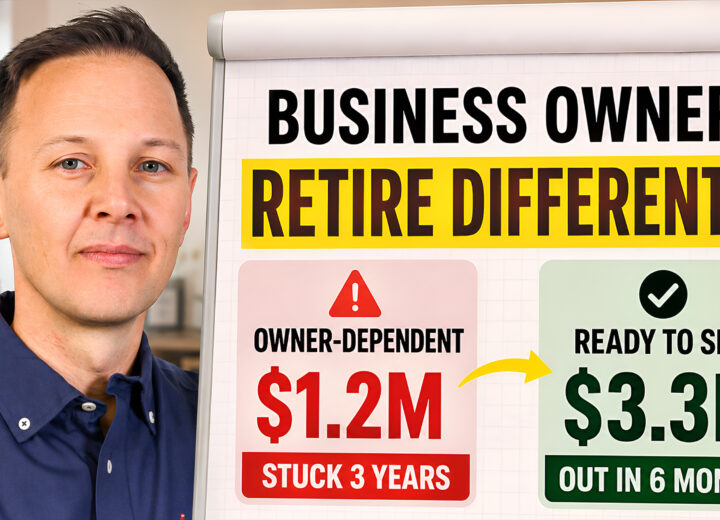
That matters for retirement planning. It matters for exit planning, too, because one of the most important parts of getting ready for an exit is reducing owner dependency. From a cash-flow perspective, that means drawing a clean line between owner compensation and the rest of the business, so a buyer can see which expenses go away when the transaction closes.
But mostly, it matters for your sanity. You already have customers, employees, vendors, payroll, taxes, and a dozen fires waiting at the office. You do not need one more thing to track every week. The more automatic your personal cash flow becomes, the more mental space you have for the business itself.
So: stop funding your life randomly. Pick a systematic amount. Coordinate the structure with your CPA. Automate it as much as you can. Your household is the reason you started the business in the first place — treat it that way.
Step 2: Set up a tax reserve before Uncle Sam becomes your silent partner
Next, you need a tax reserve. And I know — nobody likes this one.
If you are like most business owners, you probably hate paying taxes. I get it. Nobody wants to feel like Uncle Sam is standing there with his hand out every time you have a good year.
Here is the problem. If you do not set aside money for taxes when the cash comes in, that money starts to feel available. And once it feels available, you will find a use for it. You will hire someone. You will buy equipment. You will take a distribution, pay down a line of credit, or launch a marketing campaign. Then April shows up, or the quarterly estimate comes due, and suddenly you are scrambling.
So when revenue comes in, some portion of the profit needs to move into a separate tax reserve. Not later. Not when you get around to it. Not after you see how the month feels. And ideally, it happens automatically.
At the risk of repeating myself, I will repeat myself: this is not personalized tax advice. What you actually need to set aside depends on your entity structure, your state, your income level, your deductions, your estimated tax requirements, and plenty of other factors. I am not going to hand you a percentage that applies to everyone.
But the percentage is not really the point. The behavior is the point. The tax money needs to be separated before it feels spendable.
And if you are within five years of a potential exit, this gets more important, because taxes stop being just an April problem. They become an exit problem. If you sell your business, the difference between good tax planning and bad tax planning can be enormous — and much of the best tax planning needs to start years before the sale, not a few weeks before closing.
So at the day-to-day level, start with a tax reserve. At the strategic level, start building a relationship with a good CPA, a CERTIFIED FINANCIAL PLANNER professional, and a tax planning team who can help you think ahead. The last thing you want is to build a valuable business for decades and then realize too late that you could have legally kept more of what you built if you had started earlier.
Step 3: Fund business operating cash
After household cash flow and the tax reserve, the next level of the waterfall is business operating cash.
This is the money the business needs to function day to day without constant stress: payroll, rent, insurance, vendors, software, utilities, routine debt payments, regular inventory purchases, basic working capital. All the normal things required to keep the machine running.
This is not your emergency fund yet. It is not your growth budget or your exit-planning budget. It is simply the cash required to operate the business without you checking the bank balance every morning wondering whether you are okay.
Burnout is real, and it often creeps up on founders after years of fighting fires without a plan. One of the reasons owners burn out is not just the work — it is the constant mental load. The feeling that every decision, every payment, every hire, every vendor bill, every payroll run sits on your shoulders. If the business does not have enough operating cash, you never really get out of survival mode. Even when the business is profitable.
That is the part a lot of people miss. A business can be profitable on paper and still have an underfunded operating account.
How much does your business need in the operating account to run smoothly? That number varies by industry and by business, but you should know it. The goal is not to hoard cash for no reason; the goal is to create breathing room. When the business has breathing room, you can think strategically. You can stop reacting. You can stop making decisions from panic. That is when you start acting like the owner of an asset instead of the firefighter-in-chief.
Step 4: Reserve for known upcoming expenses
Next, set aside cash for expenses you can already see coming, typically within the next year.
This is different from the day-to-day operating bucket, which covers ongoing expenses. And it is different from an emergency fund. An emergency is something you did not see coming. A known upcoming expense is something you absolutely should see coming.
- If revenue slows every summer, that is not an emergency. That is seasonality.
- If a big insurance premium renews every year, that is not an emergency. That is a calendar item.
- If you know you will need to replace equipment in six months, that is not an emergency. That is planning.
If you have already committed to a large inventory purchase, a new lease, a new hire, a marketing campaign, a large debt repayment, or a big systems upgrade, that money needs to be accounted for before it becomes a crisis.
This is one of those boring financial habits that can completely change how a business feels, because a lot of “surprises” are not really surprises. They are just expenses that were never funded in advance.
So once you have your operating cash target, look forward. What is coming in the next three months? The next six? The next twelve? You do not need to predict the future perfectly, but you should have a sense of the big items coming down the pipe. Put them on the calendar. Then start setting aside for them.
A simple cash-flow forecast helps here, even an unfancy one. You may not need an MBA-level financial model, but you do need something. And as the business grows and gets more complicated, it may make sense to hire an outsourced CFO — or eventually a full-time one — because running out of cash is not an option. It is one of the biggest reasons businesses fail: the most commonly cited research on this, a U.S. Bank study attributed to Jessie Hagen, found that 82% of business failures involved poor cash flow management or a poor understanding of cash flow [1]. However you do it, the goal is to stop being surprised by things you could have seen coming.
If you are within sight of an exit, this matters even more, because buyers care about predictability. They care whether the business is well managed. They care whether cash flow is understandable.
And even before a buyer ever shows up, you care — because predictable cash flow gives you peace of mind and the ability to make better decisions. You also care because many exits are forced on an owner before they are ready, precisely because of cash-flow chaos. Plan ahead and you buy yourself the time to exit on your terms.
Step 5: Build two emergency funds
Now we get to emergency funds. A W-2 employee needs one. A business owner needs two: one for the business, one for the household.
The business emergency fund protects the company. The personal emergency fund protects your family from having to raid the company every time life happens.
Start with the business. A business emergency cash reserve — sometimes described as retained earnings — helps protect payroll, employees, customers, vendors, and enterprise value when something unexpected happens. Maybe a key customer pays late. Maybe a truck breaks down. Maybe a storm shuts down operations. Maybe revenue drops for a few months, or a project gets delayed, or a key employee leaves and you have to recruit in a hurry. That is what the business emergency fund is for.
Then, separately, you need a personal emergency fund. If every personal emergency leads to a business distribution, the business never gets to build stability. But most entrepreneurs treat the business as their personal emergency fund. Medical issue at home? Business distribution. House repair? Business distribution. Family need? Business distribution. Unexpected tax bill? Business distribution.
That can work for a while, but it keeps your business and your personal life tangled together in a way that makes planning extremely difficult. So build two separate reserves: one inside the business, one outside it.
How much? Three to six months is a common starting point for personal emergency funds, but it really depends on your situation. For the business, I do not want to be dogmatic about a number either. Three to six months of ongoing operating expenses is the figure often thrown around, but again, it depends.
Some businesses need more. If you have inventory, long receivable cycles, debt, seasonality, equipment needs, or aggressive growth plans, you may need a larger cushion. If you did the last step well and are already planning ahead for some of those items, maybe it can be a little lighter.
It also depends on your personality. I have seen owners who feel better with twelve months of operating expenses sitting in the business. Other owners would consider that too much idle cash. The right number depends on the business and on your comfort level.
The principle is what matters. Your reserves should be intentional. Not accidental. Not whatever happens to be left in the account. Intentional.
And for burnt-out owners, this is a huge step toward peace of mind. When you know the business has reserves and the household has reserves, you can finally stop treating every unexpected event like a five-alarm fire.
By the way, some of you are wondering what happens to all that extra cash when you sell. Good question — it probably deserves its own episode. For now, suffice it to say that if you truly have excess cash in the business, you can probably get some of it back out before you exit. What I see more often, though, is owners who have underfunded their cash needs and then get hit by a working capital adjustment at closing — that is the buyer’s true-up for the normal level of working capital the business needs to keep running after the sale. This is exactly why planning, and working with the right expert team, matters so much.
Step 6: Fund strategic growth and exit readiness
Once the basics are funded — household cash flow, taxes, operating cash, known obligations, and emergency reserves — we can talk about the next level: strategic growth.
This is the fun part. And if you are starting to think about an exit, this is also where you can make real progress on your valuation.
This is where you ask: what investments could make this company stronger? More profitable? Less dependent on me? More valuable to a buyer?
Maybe it is hiring another salesperson. Maybe it is launching a marketing campaign, expanding into a new territory, or buying equipment that improves margins. Maybe it is investing in technology, adding a recurring revenue line, or hiring a general manager or operations leader so everything stops running through you.
Here is the key: at this stage, you do not want growth for growth’s sake. If you are thirty years old and still fighting toward profitability, maybe you think differently. But if you are starting to think about selling and exiting on top, every major growth investment should be filtered through a few questions:
- Will this increase profitability?
- Will this make revenue more predictable?
- Will this reduce customer concentration?
- Will this reduce owner dependence and strengthen my management team?
- Will this make the business more transferable, and therefore more attractive to a buyer?
That is the difference between generic growth and strategic growth. Because not all growth creates value. Sometimes growth creates complexity. Sometimes it creates risk and chaos. Sometimes it creates more revenue at lower margins. Sometimes growth even makes the business less valuable. And if you are already burned out, the last thing you need is a bigger, more stressful version of the same problem.
So yes, fund strategic growth after the basics are covered — but aim it at building a better business, not just a bigger one.
And when I say a better business, by definition I also mean a sellable business. An exit-ready business. Getting there may include things like:
- Getting a business valuation
- Doing tax planning
- Meeting with an exit planner
- Cleaning up legal documents
- Reviewing your operating agreement
- Strengthening the leadership team (and the culture underneath it)
- Reducing customer concentration
- Shifting to more recurring revenue
- Documenting key processes
- Coordinating your estate plan
- Preparing for a quality of earnings review
- Building a personal financial plan around the eventual sale
Some of those things sound expensive, and some of them can be. Others mostly require time to think and staff to help execute.
But here is the important point: done well, exit-readiness initiatives can have an enormous return on investment. If you spend money on planning, consulting, tax strategy, or operational improvements, and that work increases the value of the business, improves deal terms, reduces taxes, or helps you avoid a bad sale structure, the payoff can be many times the cost.
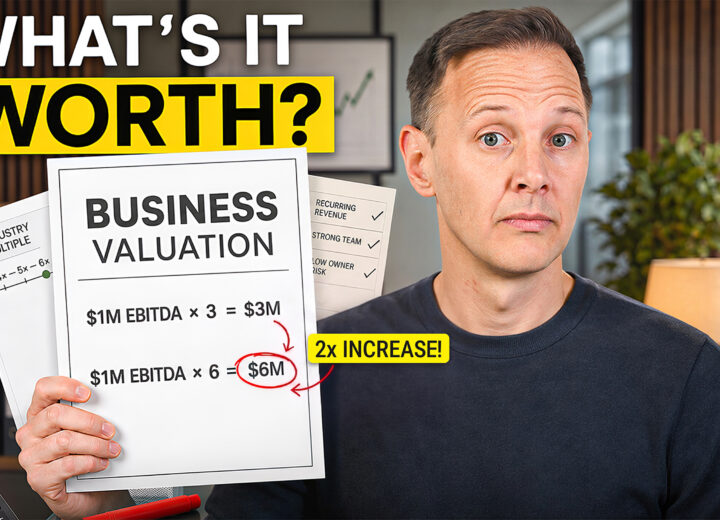
In many cases these are tax-deductible business expenses. And in some cases, certain nonrecurring consulting or transaction-preparation costs may be add-back candidates when calculating adjusted EBITDA — that is, earnings before interest, taxes, depreciation, and amortization, adjusted for one-time items, which is the profit figure most buyers actually price off of. More on that in future episodes.
I do want to be careful here. That does not mean these things are literally free. Your CPA, attorney, exit planner, and deal team need to weigh in, and the rules are nuanced.
But the bigger idea is this: do not think of exit planning as just another expense. Think of it as an investment in the most important financial transaction of your life. If you are within sight of a possible exit, the work you do now may determine whether you sell at a discount, sell on good terms, or cannot sell at all.
Step 7: Pull out and invest excess cash
Finally, once the higher-priority buckets are funded, excess cash can come out of the business and be invested. This is where additional personal wealth building comes in: taxable brokerage accounts, retirement accounts, Roth accounts where appropriate, real estate, charitable planning, college savings, estate planning strategies — whatever fits your situation and your goals.
The key is that the cash comes out intentionally. Not randomly. Not because the account looks flush. Not because you had a good month and are feeling good. Not because you are tired and want to reward yourself. Intentionally.
By the time you reach this step, the business has already funded your household needs. It has set aside for taxes. It has enough operating cash. It has planned for known obligations. It has emergency reserves. It is funding strategic growth and exit readiness. If there is excess cash beyond all of that, you can pull it out and build personal wealth.
This matters because the more wealth you build outside the business, the less pressure you put on the eventual sale. If the sale goes perfectly, wonderful — that outside wealth becomes the cherry on top. But if the business sells for less than expected, takes longer than expected, or triggers more taxes than expected, your outside wealth may be the thing that protects your financial independence.
This is where owners often need help, because the question is not simply “should I invest more?” The real questions are harder:
- How much should stay in the business, and how much should come out?
- Which accounts should it go into, and how should it be invested?
- How does this connect to the future sale?
- How much risk should I take?
- What tax strategies apply?
- What happens if I sell in three years? In seven? What if I never sell?
That is where personal financial planning and business exit planning have to come together. For a business owner, those are not two separate conversations. They are the same conversation.
Bringing it all together
If you are a business owner within sight of a potential exit, you need a cash-flow waterfall. Not because you need one more complicated system, and not because you want to spend your nights staring at spreadsheets — but because your money has too many jobs, and without an order of operations, every decision becomes a fresh debate. A waterfall puts the debate to bed.
- Pay yourself on purpose.
- Set up a tax reserve before Uncle Sam becomes your silent partner.
- Make sure the business has sufficient operating cash.
- Set aside for known upcoming expenses.
- Build two emergency funds — one for the business, one for your household.
- Fund strategic growth and exit planning opportunities.
- Pull out and invest excess cash.
That is the order. Your exact waterfall may look slightly different depending on your business, your goals, and your planning team, but the principles are the same.
Stop making every cash-flow decision from scratch. Stop running your financial life by gut feel. Stop letting the business account balance determine your peace of mind. Create a system. Because the goal is not just to survive the next payroll. The goal is to build a business that supports your life today and can help fund your freedom tomorrow.
Ready to go deeper?
If you are reading this and thinking, “this makes sense, but I have no idea what my cash-flow waterfall should actually look like,” that is exactly the kind of work we do. At DeepRiver Wealth, we help business owners connect their personal financial plan with the value of their business, their tax picture, and their eventual exit — because for entrepreneurs, those things cannot be separated.
Your business is probably your largest asset. Your future may depend on whether it becomes sellable. And the next five years may determine whether decades of work turn into lasting wealth or simply another job you cannot escape.
- Find out what your business might be worth with our free business valuation assessment.
- Estimate your number with the Founder Freedom Calculator — what you have, what you need, and the gap between them.
- Read the full roadmap in my book, The Entrepreneurship Trap.
- See how exit planning works on our exit planning page.
- Talk it through with us — start here.
- Subscribe to the Founder Money Podcast on YouTube so you do not miss the next episode.
Until next time — this is Curtis Hearn, and you are reading (and listening to) the Founder Money Podcast.
Frequently Asked Questions
-
What is a cash-flow waterfall for a business owner?
A cash-flow waterfall is a simple order of operations for money coming into your business: which bucket gets funded first, second, and third. For business owners, that order runs from household pay, to a tax reserve, to operating cash, to known upcoming expenses, to emergency funds, to strategic growth, and finally to investing excess cash outside the business. The point is to stop debating every decision from scratch.
-
How much cash should a business keep in reserve?
It depends on the business. Three to six months of ongoing operating expenses is the figure most often thrown around as a starting point, but businesses with inventory, long receivable cycles, debt, seasonality, or aggressive growth plans may need more. Some owners sleep better with twelve months; others would see that as too much idle cash.
-
How much should I set aside for taxes?
There is no single percentage that applies to everyone — it depends on your entity structure, your state, your income level, your deductions, and your estimated tax requirements, so this is a conversation for your CPA. The behavior matters more than the number: move the tax money into a separate reserve when revenue comes in, before it starts to feel spendable.
-
Should I pay myself a salary or take distributions?
That depends on how your business is structured, and the accounting and tax treatment varies, so coordinate it with your CPA and tax planning team. What matters from a cash-flow standpoint is that the amount is systematic and predictable rather than a series of random dips into the business account — which is also what lets a buyer see clearly which expenses go away at closing.
-
Does leaving extra cash in my business make it worth more when I sell?
Not automatically. If you truly have excess cash in the business, you can often get some of it back out before you exit. The more common problem I see is the opposite: owners who have underfunded their cash needs and then get hit with a working capital adjustment at closing. This is one of the reasons to start exit planning early, with the right team around you.
Sources
[1] The claim that cash flow problems are among the leading causes of small business failure is most commonly attributed to a U.S. Bank study by Jessie Hagen, which found that 82% of business failures involved poor cash flow management or a poor understanding of cash flow. See, e.g., SCORE, “The #1 Reason Small Businesses Fail — And How to Avoid It”: https://www.score.org/articles/1-reason-small-businesses-fail-and-how-avoid-it/
Disclosures
Advisory services offered through NewEdge Advisors, LLC, a registered investment adviser. This material is for educational and informational purposes only and is not intended as personalized financial advice. The strategies discussed may not be suitable for everyone. DeepRiver Wealth does not provide tax or legal advice. Please consult a qualified tax or legal professional regarding your specific situation.
Advisory services are only offered to clients where NewEdge Advisors and its representatives are properly licensed or exempt from licensure. Past Performance is no guarantee of future returns. Investing involves risk and possible loss of principal capital. No advice may be rendered by NewEdge Advisors unless a client service agreement is in place. The content of this article is developed from resources believed to be providing accurate information; however, neither DeepRiver Wealth nor NewEdge Advisors, LLC, guarantees the accuracy or completeness of any information obtained from any third party. The information in this material is not intended as tax, legal, or financial advice.