Founder Money Podcast — Episode 2 | By Curtis Hearn, CFP, CEPA, MBA
Watch/listen on your favorite platform: Spotify | Apple Podcasts | YouTube
Why Selling a Business Is Personal for Me
I’m Curtis Hearn. I’m a Certified Financial Planner and a business exit advisor, and I run DeepRiver Wealth, a firm that specializes in financial planning for business owners and their businesses. But ten years ago, I was in a very different spot. Ten years ago, I was burnt out. The kind of burnt out that makes you wonder whether you should give it all up and start over with something new. I loved the work, at least initially. I was at a local wealth management firm, helping build it from the ground up. I had responsibility, opportunity, and the chance to leave my mark, including the chance to buy in and own a small stake in the firm. But all that opportunity came with 80-hour weeks, constant stress, and a growing to-do list. Like most small businesses, we did everything ourselves: managing staff, payroll, investment portfolios, trading, marketing. We were reinventing the wheel and micromanaging the team far too much. My partner, Jon, saw the toll it was taking and kindly suggested a sabbatical. So I took a couple of months off and traveled the world. And it worked. I came back with a new perspective and new ideas for the company. Unfortunately, that renewed drive was all for naught. When I got back, I found out that Jon, the firm’s founder and majority owner, was burnt out too. So burnt out that he had decided to sell the business. While I was away, he had been meeting with buyers and negotiating terms. It felt like the rug had been pulled out from under me. Jon was my mentor; he had taught me everything I knew, and we had worked so hard to build the company together. If we sold, I would lose my position and end up working for someone else. It felt like a demotion. But as a minority owner, I didn’t really have a say. So we sold the firm. And while the financial payout was gratifying, we had no idea what we were getting into. The process was a minefield of risk, regret, and pressure. We survived a stressful earn-out, a new management culture, turnover of more than half of our employee base, and, most painful of all, a stinging lack of control. Every change brought a new level of stress, until finally it was over. Frankly, it’s not a process I would wish on an enemy. But there was a silver lining. I got to witness something very few people ever do: a business exit from the inside. I saw our team of experts, our CPA, attorney, and consultants, not always agreeing but always pushing toward our best interests. I felt the pressure of negotiations, due diligence, and earn-out targets. I dove into complex tax planning and the careful investing of the sale proceeds. It was a crash course in small business M&A, as educational as it was overwhelming. My favorite part, though? The real privilege? I got to write the financial plan for Jon, my partner and the founder of the business. As I record this, his plan is still solidly on track, and he’s enjoying a well-deserved retirement. I share all this so you understand that exit planning is not an academic exercise for me. It’s personal. After we sold that company, I knew I wanted to start my own firm to help business owners not only plan their personal finances, but integrate their businesses into their personal wealth journeys. Since then, I’ve become a Certified Exit Planning Advisor and focused my career on helping business owners get the exit they deserve, just like Jon.What We’ll Cover (and Why I’m Telling It as a Story)
In this episode, I’m condensing a lot of that hard-won knowledge into one place. By the end, I hope you’ll feel more confident when you think about selling your own business one day. Here’s the ground we’ll cover:- How to make your business not just profitable but sellable, and how to catch the red flags before buyers do.
- How to gather the right team of experts who will go to bat for you.
- The different types of buyers out there, and how to know which is the best fit for you.
- Some important post-sale pitfalls to watch for.
Meet Mike and Sarah
Mike runs a marketing company. He does $3 million in revenue and is 18 years in. He has always loved marketing: the ideation, the design, the clients. Building the business was his way of doing what he loved on his own terms. Because of that, Mike is hands-on in every aspect of the business, and his customers love it. They appreciate the personal connection and are grateful to work with someone they trust. Sarah runs a similar business. Same revenue, same industry, same number of years in business. Sarah also started her company out of a love for marketing, but over the past few years she has shifted her role to be more hands-off. Sometimes she misses the work, but she’s happy that her team is happy and that everything is running smoothly. Or as smoothly as you can hope for when you run a business. Both are thinking about selling in the next few years. Both think they’re ready. But what “ready” actually means is what we’re about to find out.Step 1: Make Your Business Sellable, Not Just Successful
A sellable business starts with one question, the one most owners never stop to ask themselves: “Would anyone actually want to buy this?” That question is the key to turning a successful business into a sellable one. And it’s where Mike starts to fall behind.Mike’s business through a buyer’s eyes
Let’s look at Mike’s situation, but this time from a buyer’s perspective. Three things stick out immediately. First, the books. Mike’s accountant is his brother-in-law. Nice guy, but not a specialist. Most of the bookkeeping lives in Google Sheets, and the line between personal and business expenses is muddy at best. All of it is legal, but it’s a red flag to any buyer. Without clean records, it’s hard for them to know exactly what they’re buying. Second, client concentration. Mike has three clients that make up 65% of his revenue, and they’re all in the same industry. If any of them leave after the sale, the business takes a massive hit. No matter how happy those clients are with Mike, there’s no telling what happens when new management takes over. That concentration is a huge risk for a buyer. Third, and this is the real kicker: Mike is the business. Without him, it doesn’t run. He closes the big contracts, he’s the one clients trust, and he makes the final call on everything. Mike is proud to have built the business himself, but all a buyer sees is a gaping, Mike-sized hole in the center of the company. If Mike runs it all, what happens when he leaves? Are you starting to see the cracks?Sarah’s business through a buyer’s eyes
Sarah’s books are clean. It costs her more, but a few years back she hired a CPA who specializes in small business accounting and taxes. Around the same time, she completely separated her business and personal expenses. She still takes every tax deduction she’s entitled to, but everything is clearly documented, so a buyer can see which costs are ongoing and which would end when the deal closes. She also outsourced payroll and HR to an expert third party. Her records are clean enough to be audit-ready and clear enough that buyers won’t worry about hidden liabilities surfacing down the road. That will become crucial when Sarah negotiates her price. Her client base is diversified, too. No single client makes up more than 10% of her revenue. She could lose a few and still come out with a healthy profit. Her clients also span multiple industries rather than depending on one sector of the economy. Since it’s only a matter of time before a downturn hits at least one area, that kind of protection is a big comfort to buyers. Most importantly, she has built her business to run without her. A general manager handles daily operations. Her sales and service teams own the client relationships. Every process is documented, and whatever can be automated, is. (If you want to understand why a strong team and culture matter so much to buyers, I wrote about it in The Importance of Culture in Scaling and Selling Your Business.) Mike and Sarah seemed to have very comparable businesses at the start. Now, not so much. This is why getting out of the “owner” headspace and into a buyer’s mindset changes everything. You start seeing your business through an entirely different lens.A quick sellability check for your own business
Take a minute and run this exercise on your own company:- Are your books clean, organized, and ready for an audit?
- Does each of your clients make up 15% or less of your revenue?
- Do you have clear systems documented and in place?
- Can you step away from the business for a month or two without it taking a hit?
Step 2: Get a Real Business Valuation (Don’t Guess)
The next step, and the one most owners skip entirely, is getting a business valuation. To sell something, you have to know what to price it at, right? You’d think so. But most business owners walk into a sale without a clue. According to a poll by M&T Bank reported by CNBC [1], as many as 98% of business owners don’t know what their business is actually worth. Mike is one of them.How businesses are actually valued
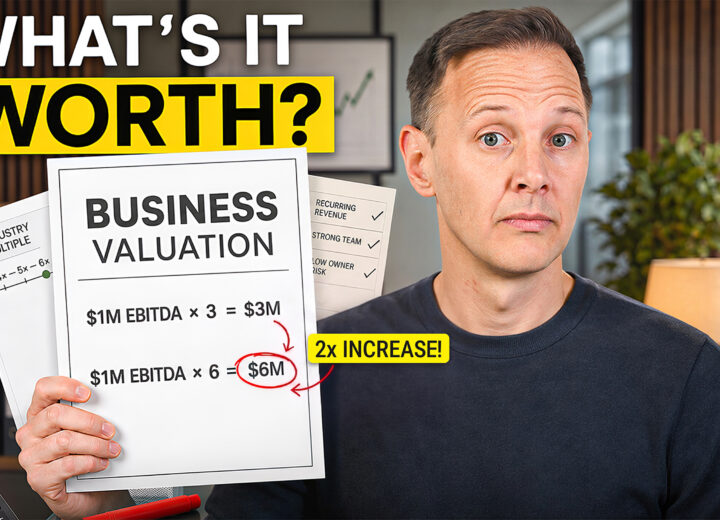
Mike does what the vast majority of owners do: he guesses. And he guesses way too high. With some quick math and a gut feeling, he lands on $6 million. That seems to make sense to him. With $3 million in revenue, a buyer would make the money back in a couple of years, right? Well, no. Most businesses are not valued on revenue. They’re valued on profit, and more specifically, on the profit a new buyer can expect to make. The most common measurement for this is adjusted EBITDA, a fancy acronym for earnings before interest, taxes, depreciation, and amortization. Think of it as a standardized picture of the business’s operating profit. Your business’s value is based on a multiple of that number, not of revenue.Mike’s rough valuation
Mike didn’t get a professional valuation, but let’s do a rough one for him anyway. His revenue may be $3 million, but his adjusted EBITDA, his operating profit, is only about $600,000. And his multiple? Because his client concentration is so high and the business depends so heavily on him, a buyer isn’t going to pay the high end of the range for his industry, which would be 5x or 6x. He’d be lucky to get 3x. Remember, Mike’s business is great for Mike. It’s not great for a buyer. With that EBITDA and multiple, Mike’s business is far from his $6 million guess. The actual number is probably somewhere between $1.2 million and $1.8 million. Call it $1.5 million for now. And that assumes he can sell it at all, which is far from guaranteed. In its current state, it might actually be worth zero.Sarah’s valuation
As you can probably guess, Sarah got her business valued about two years before she planned to sell. She pulled together three years of financials and went through a formal valuation process. She learned that her EBITDA is about $500,000, slightly less than Mike’s. But because her client base is diversified, because she has systems in place, and because the business runs without her, it commands a multiple of 4x. And after meeting with her Certified Exit Planning Advisor, or CEPA, she learned some important tweaks that could bump it up to 6x before she sells. Despite her lower EBITDA, Sarah is expecting a valuation of about $3 million. That’s twice what Mike’s business is worth. Not that Mike knows that. Again: same revenue, same industry, same part of the country. Both businesses are successful, but only one is sellable. And that makes all the difference. If you’re realizing you’re more like Mike and you don’t know your valuation, don’t worry. We have a free business valuation tool that walks you through it step by step. The best part? It only takes about 10 minutes.Step 3: Gather Your Exit Team
Now Mike and Sarah both have a sale price in mind and are getting ready to make a move. Both know they can’t do this alone. That brings us to Step 3: gathering the team. Mike, once again, takes the approach most owners take. He talks to his brother-in-law, the same guy who keeps his books in a spreadsheet. He also calls his attorney, who is a great general business attorney but has limited experience in M&A transactions. And that’s that. Sarah takes a different approach. She assembles a whole team specifically for this transaction. She has never done this before, so why not bring in experts who have? She hires four key people.The M&A advisor
This person is in charge of finding the right buyers, getting the best deal, and managing the transaction process. Sarah makes sure to choose someone who has worked with businesses like hers and has connections in her industry.The attorney
Not just any attorney. This one drafts all the contracts, from the purchase agreement to the non-solicits and key employee agreements. They handle legal exposure, compliance, and due diligence, and they even help negotiate the structure of the deal. Their main job is to protect you.The CPA
Then she needs help with taxes. That’s the one thing Mike and Sarah definitely have in common: they hate taxes. Sarah shops around to be sure, but sticks with her current CPA, the one who specializes in small business taxes. They already have a great relationship, and more importantly, the CPA has experience in similar deals.The financial planner
I saved the best for last. The last core member is the most important, and usually the first to be hired: the financial planner. They lead and coordinate the whole team. Sarah’s financial advisor has a solid understanding of both her personal and business finances. They understand her goals, her risks, and how all the pieces fit together. But Sarah doesn’t settle for just any financial advisor. She finds someone trained as both a CFP professional and a Certified Exit Planning Advisor, so they can not only speak the language of the other specialists, but coordinate the entire team toward her goals. Remember: selling your business is likely going to be the largest and most important financial transaction of your life. It’s worth hiring experts who are looking out for your best interest. And if you hire right, they will more than make up for their cost. If you want a deeper dive into who to hire and how to hire well, I unpack all of that and more in The Entrepreneurship Trap.Step 4: Find the Right Buyer
With the teams assembled, Mike and Sarah move on to Step 4: finding the right buyer. When you sell your business, there are many options, and each has pros and cons. It’s not about finding the single best option. It’s about finding the one that’s best for you. Let’s walk through four, and I’ll show you which might make sense for Mike and which might make sense for Sarah.Option 1: A strategic buyer
A strategic buyer is typically a competitor in your industry or an adjacent one, usually larger than you. They may be down the street, or they may be trying to enter your local market. They usually already have the staff, equipment, and know-how to start serving your customers immediately. Your business simply gives them scale, which has immediate financial benefits. For these reasons and more, strategic buyers tend to pay the most. For Mike, an outside buyer would do due diligence and quickly discover the owner dependence, the client concentration, and the messy books. They’d likely walk away or demand significant concessions. For Sarah, an outside buyer would see a clean, systematized business and likely offer competitive terms. This could give Sarah the cleanest exit at the most competitive price. But she’s hesitant. She has spent years building her team and cares about them, and a competitor buyout could mean doubled-up roles and her people getting cut.Option 2: A private equity group (PEG)
Private equity has a bad rap, but don’t dismiss it out of hand. There are thousands of private equity groups out there, so the odds are good you can find one whose strategy and values align with yours. It may take kissing a few frogs, but if you take the time, the benefits can be significant. PEGs typically pay among the highest multiples, sometimes even more than strategic buyers, because they have a proven playbook for growing value even further. If you’re considering a PEG, I’ve put together a free list of essential questions to ask any private equity buyer. Check it out. For Mike, a PEG would likely see his owner-dependent business and immediately rule it out for top pricing. One of private equity’s core strategies is to buy a “platform company,” a business they can easily scale because it already has a strong foundation. That sounds a lot more like Sarah’s business than Mike’s. At best, Mike’s business would be considered for a “bolt-on” acquisition, where they buy it and attach it to a stronger platform company to mitigate its weaknesses. They’d also probably want to lock Mike in with an earn-out, so he has to keep working to collect his full sale price. And even then, they’d almost certainly discount the price because the business can’t run without him. Mike would end up selling for less and still having to work. For Sarah, a private equity group would see a systematized business and might offer a premium valuation, plus the option, but not the requirement, to run the new platform company. If she’s ready to walk, she’d likely have that option, because the business already runs without her and the PEG would simply install a professional CEO. In short, private equity could be a strong exit option for Sarah if she can find a group that aligns with her goals.Option 3: A management buyout
This is where your existing leadership team buys the business. The transition is usually very smooth, since they already know the business and the clients. The disadvantage is financing. Your management team may not be able to pay as much as an outside buyer, and they may need you to finance part of the purchase yourself. For Mike, a management buyout might be the only realistic option. His team is loyal and knows the clients. But they’d struggle to finance a large purchase, and Mike would likely end up seller-financing part of it, meaning he stays financially tied to the business after he sells. Worse, because the business still depends on Mike, there’s a real risk the management team accidentally runs it into the ground, jeopardizing his financial future. For Sarah, a management buyout could work well. Her general manager is already running the business, so the transition would be seamless. But she would likely get a lower price than she could from private equity or a strategic buyer, and she’d probably have to seller-finance as well. It’s a trade-off: less money, but more certainty and a cleaner exit. There are also strategies to help mitigate the risk in certain owner-financing scenarios.Option 4: An ESOP
An employee stock ownership plan, or ESOP, allows your employees to gradually become owners of the company through stock ownership. You get to reward the people who helped you build it and keep the culture and values of your business intact. You also avoid earn-outs and rollover equity, and the tax advantages can be significant. If you sell to an ESOP and reinvest the proceeds into qualified securities, you can potentially defer, and even eliminate, capital gains taxes. That said, it’s not all perfect. ESOPs are complicated and expensive to set up. Costs can run into the tens of thousands of dollars or more. There are additional compliance requirements, and the business will likely have to take on some debt. For Mike, an ESOP might sound appealing because his team knows the business. But the problem is the same: the business is too dependent on him. An ESOP would still need Mike to stay on, and the valuation would reflect that risk. For Sarah, an ESOP could be an excellent fit. Her business runs without her, so the transition would be smoother, and she could take advantage of the tax benefits. But she’d need to weigh those benefits against the setup costs and ongoing compliance. I can’t tell you which option is best for Mike or Sarah. That’s for them and their teams to decide. It all depends on their unique financial situations and their goals: their financial goals, their exit goals, and their legacy goals. That’s exactly why building a team of experts you trust matters so much.Step 5: Negotiation, Due Diligence, and the Transition
Once they’ve found the right buyer, the next step is negotiation, due diligence, and transitioning. I want to focus on where this process can fall apart, because these are the moments that cost owners real money. And Mike is about to hit almost every one of them.Pitfall 1: Earn-outs
An earn-out is where part of your purchase price is tied to the business hitting certain targets after the sale. The buyer says, “We’ll pay you half now and the rest over the next two years, but only if you hit these targets.” Sounds reasonable. Here’s what actually happens: you’ve sold the business, and you don’t control it anymore. The new owner changes strategy, cuts the marketing budget, and reorganizes the team. Revenue drops, and you don’t get the other half of your so-called sale price. Remember that stinging lack of control I mentioned earlier? That’s why. Mike’s deal includes a significant earn-out, because the buyer isn’t confident the business can perform without him. They’re hedging their risk with Mike’s money. Sarah’s deal? Her M&A advisor pushed back hard on earn-outs. Because her business has predictable, documented performance, the buyer didn’t need that hedge. Sarah’s deal is mostly cash at close. My advice: read earn-out clauses carefully and negotiate hard against them. But more importantly, build your business to the point where you’re in a position to negotiate in the first place.Pitfall 2: Due diligence surprises
Buyers dig into everything before closing: your financials, your contracts, your employee agreements, your insurance, your litigation history. If there’s a problem, they will find it. Mike gets hit hard here. The buyer finds the client concentration risk. They find that two key employees don’t have non-solicit agreements. Each discovery becomes a negotiating point, and the price keeps dropping. Sarah’s due diligence? Her records are organized, her contracts are current, and her team has proper agreements in place. Due diligence is never simple, even for the most organized business, but nothing stalls and no red flags pop up. The buyer moves through quickly, and the deal stays on track. If you haven’t prepared for due diligence, you’re not ready to sell.Pitfall 3: Owner dependence
I keep coming back to this because it’s the number one deal-killer I see. If the business can’t function without you, the buyer will want you to stay on afterward, will heavily discount the price, or, most likely, both. Mike is facing this right now. The buyer wants him to stay for three years. Mike thought he was selling his business and walking away. Instead, he’s signing up for three more years of employment with someone else making the decisions. Sarah? The buyer is asking for a six-month advisory period. That’s it.Pitfall 4: Emotional decisions
You’ve built this thing for years. It’s part of your identity now. No matter how sure you are, when the moment comes to sign the papers, you may get cold feet. Or you make decisions based on ego or fear instead of math. Mike is already showing signs of this. He’s emotional about the price because he feels the business should be worth more. He’s not making decisions based on what the market is telling him. He’s making decisions based on what he feels he deserves, and it’s costing him. Sarah’s financial advisor is keeping her grounded. When the first offer came in lower than expected, her advisor helped her evaluate it objectively, not emotionally. That objectivity got her to a better deal.Mike Is Not a Caricature
Walking through Mike and Sarah’s stories, it might seem ridiculous how underprepared Mike is to exit his business. If you’re not a business owner, you might be wondering, “Do people actually do this?” From start to finish, it’s a mess. It starts to feel like he’s careless, ignorant, or even flat-out lazy. But Mike is not a caricature. He’s not careless or ignorant, and he’s definitely not lazy. Despite his grit, dedication, and industriousness, the data show us again and again that Mike represents the vast majority of business owners out there. Mike didn’t grow up wanting to be an entrepreneur. He wasn’t taught about personal finances, let alone business finances. He just loved marketing. His days are spent keeping clients happy, making payroll every month, and keeping up with an ever-changing industry. You can hardly blame him for never stepping back to plan for the business instead of just running it. But as much as I sympathize with Mike, and remember, I used to be Mike, the numbers don’t.Where Mike and Sarah End Up
Mike sells his business for $1.2 million, less than a quarter of what he expected. After taxes, after debts, and after an earn-out he probably won’t fully collect, he takes home about $800,000. That gives him roughly $32,000 a year in retirement income. He’s also committed to a three-year transition he didn’t want, and he’s emotionally drained from a process that felt like a fight instead of a victory. Sarah sells her business for $3.3 million. After taxes, which, by the way, could probably be mitigated through careful tax planning, she’s sitting on about $2.2 million. That gives her roughly $80,000 a year in retirement income, using the Rule of 25 (a common planning rule of thumb, not a guarantee) and assuming a well-managed investment portfolio. She’s out in six months, and she’s moving into the next chapter of her life with confidence and clarity. Same revenue. Same industry. Same years of work. But a $2.1 million difference in sale price, a $56,000 difference in annual retirement income, and two and a half more years of Mike’s life tied to a business he wanted to leave. The difference wasn’t luck, and it wasn’t the market. It was preparation, starting years before the sale. It was making intentional decisions about how to build the business. It was keeping the end in mind, bringing in the right team, and getting a real valuation instead of guessing.Your Exit Doesn’t Have to Look Like Mike’s
Selling your business doesn’t have to look like Mike’s story. But that doesn’t happen by accident. It happens because you started preparing early, and because you made your business something someone would actually want to buy. You’ve built something worth protecting. Now protect it.- Find out what your business is worth. Use our free business valuation tool. It takes just a few minutes and gives you a starting point.
- Talk to us. If you’re serious about planning your exit, schedule a free consultation with DeepRiver Wealth. This is likely the largest transaction of your life, and you shouldn’t navigate it alone.
Frequently Asked Questions
-
How do I know if my business is sellable?
Start by looking at it the way a buyer would. Four quick tests: Are your books clean and audit-ready? Does each client make up 15% or less of your revenue? Are your systems documented? Could you step away for a month or two without the business taking a hit? A "no" on any of these is a red flag to buyers and a good place to start making changes.
-
How is a small business valued when you sell it?
Most businesses are valued on a multiple of adjusted EBITDA (earnings before interest, taxes, depreciation, and amortization), not on revenue. Two businesses with identical revenue can be worth very different amounts if one has diversified clients, documented systems, and can run without the owner. You can get a starting estimate with our free business valuation tool.
-
Who should be on my team when selling a business?
In this episode I describe four core members: an M&A advisor to find buyers and run the process, an attorney experienced in M&A to draft and negotiate the contracts, a CPA who knows small business taxes and has done similar deals, and a financial planner, ideally a CFP professional who is also a Certified Exit Planning Advisor, to lead and coordinate the whole team.
-
What is an earn-out, and should I accept one?
An earn-out ties part of your sale price to the business hitting targets after the sale, when you no longer control it. If the new owner changes strategy and revenue drops, you may never collect the rest. Read earn-out clauses carefully and negotiate hard against them, and build a business with predictable, documented performance so the buyer doesn't feel the need for that hedge.
-
What types of buyers are there for a small business?
The four I cover in this episode are strategic buyers (usually a larger competitor), private equity groups, a management buyout by your existing leadership team, and an ESOP (employee stock ownership plan). Each has trade-offs in price, certainty, tax treatment, and what happens to your team, so the right one depends on your financial, exit, and legacy goals. If you're considering private equity, see our essential questions to ask a private equity buyer.
-
When should I start preparing to sell my business?
Years before you plan to sell. In the episode, Sarah got her formal valuation about two years before her planned exit and had already spent several years cleaning up her books, diversifying clients, and building a team that could run the business without her. The earlier you start, the more options you have. Learn more about exit planning.
Sources
[1] “Most Small Business Owners Don’t Do the Math on Their Most Valuable Asset.” CNBC, July 17, 2022. Statistic originally reported from an M&T Bank poll. Available at: https://www.cnbc.com/2022/07/17/most-business-owners-dont-do-the-math-on-their-most-valuable-asset.html
Disclosures
Advisory services offered through NewEdge Advisors, LLC, a registered investment adviser. This material is for educational and informational purposes only and is not intended as personalized financial advice. The strategies discussed may not be suitable for everyone. DeepRiver Wealth does not provide tax or legal advice. Please consult a qualified tax or legal professional regarding your specific situation.
Advisory services are only offered to clients where NewEdge Advisors and its representatives are properly licensed or exempt from licensure. Past Performance is no guarantee of future returns. Investing involves risk and possible loss of principal capital. No advice may be rendered by NewEdge Advisors unless a client service agreement is in place. The content of this article is developed from resources believed to be providing accurate information; however, neither DeepRiver Wealth nor NewEdge Advisors, LLC, guarantees the accuracy or completeness of any information obtained from any third party. The information in this material is not intended as tax, legal, or financial advice.